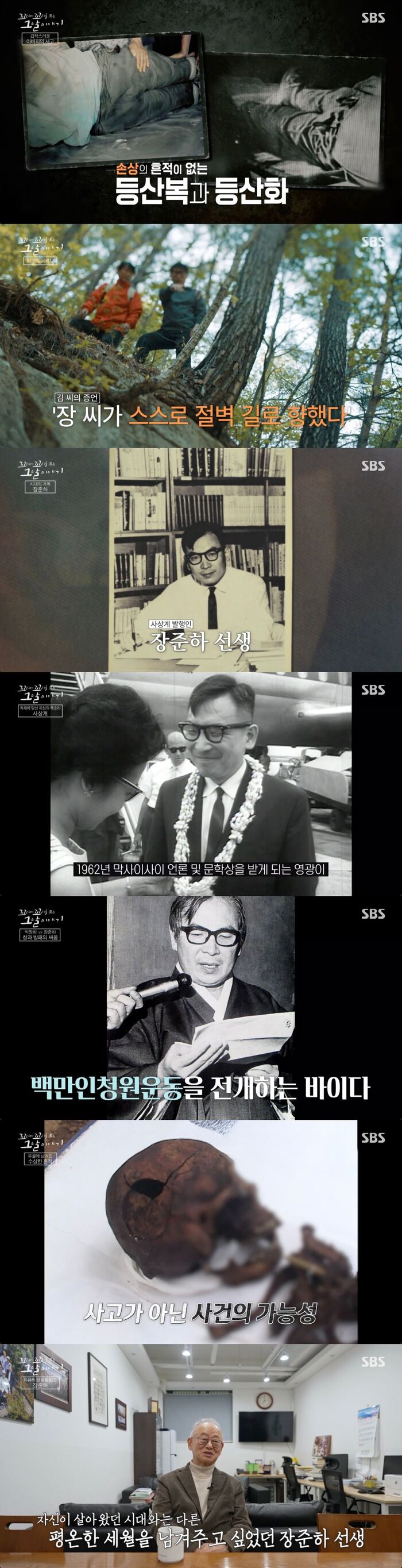
The August 14th episode of SBS’s ‘Kkokkomu’ (Tail to Tail) tracked the mysterious death of a man that occurred in August 1975.
On August 17, 1975, a man was found dead at Yaksa-bong on Mt. Unak in Pocheon, Gyeonggi Province. While it was ruled as a death by falling, the state of the body was suspicious. His hands were clean, his clothes were intact, and his glasses were completely scratch-free, which are details that do not align with someone who slipped and fell down a mountain.
The reason it was ruled a fall was simple: there was a witness. The case was closed based on the testimony of a man identified as Mr. Kim.
The sole witness, 41-year-old Mr. Kim, claimed he followed Mr. Jang to the summit after Jang had headed up alone. Shortly after, he reported that Mr. Jang had fallen. However, it was strange that Mr. Kim had checked Mr. Jang’s schedule the day before and followed him.
Three days after the incident, Mr. Kim visited the funeral and claimed that Mr. Jang had shared coffee with soldiers before climbing the summit with him. He stated that once they reached the top, Mr. Jang led the way down a valley path, suggesting it was a shortcut.
Kim claimed Mr. Jang fell while leaning on a tree, insisting he saw the tree bend. He said he rushed down the valley to perform CPR, but when there was no response, he called other hiking club members for help. He claimed all of this happened within two hours.
However, such a feat would be impossible even for a professional climber. Furthermore, the identities of the two soldiers who reportedly shared coffee with Mr. Jang could not be verified. A reporter who investigated the case, suspicious of an incident occurring in a military protection zone where civilians are restricted, was suddenly forced to stop his coverage and was later arrested for spreading rumors. He had received orders from superiors to close the case and “act as if they didn’t know.”
The man who died at Yaksa-bong was Jang Jun-hwa, the publisher of the general culture monthly Sasanggye (World of Thought), who was considered a symbol of intellectuals.
Sasanggye became a beacon of the era by criticizing a political circle that pursued its own interests rather than those of the people. Consequently, many people were displeased with Mr. Jang.
Mr. Jang felt a deep sense of shame and apology, believing that he and other adults had failed to properly protect and correct the country in the face of a corrupt government and political sphere.
He continued his sharp criticisms not only of the Rhee Syngman regime but also of the military regimes. In 1962, he received the Magsaysay Award, often called the “Nobel Prize of Asia.”
From that point on, a campaign to destroy Sasanggye began. Eventually, Mr. Jang stepped down as publisher after being buried in debt. Later, he ran for the National Assembly and won his first election with overwhelming support.
Mr. Jang took responsibility and spoke out against the corruption of the Park Chung-hee regime. He led a million-person petition movement demanding the revision of the current constitution in response to the regime’s repeated constitutional amendments, aiming to convey the public’s opposition to the dictatorship.
However, Park Chung-hee labeled him a “subversive element” and threatened him publicly. Despite this, Mr. Jang did not bend his will, and the Park Chung-hee regime continued to persecute him.
After being arrested three times under the Park Chung-hee regime, Mr. Jang met a suspicious end. Following his death, his family faced terror. Eventually, his son left Korea, and the remaining family members were forced into silence.
“Survive until the end, overcome every hardship,” following the teachings of Mr. Jang’s wife, the family gritted their teeth and endured.
Later, in 2003, investigators from the Truth and Reconciliation Commission re-examined Mr. Jang’s death. They noticed several suspicious points. For instance, the witness, Mr. Kim, had called Mr. Jang’s family to inform them of his death before the police or the hospital did. Additionally, it was revealed that Mr. Kim, who had suddenly disappeared from the scene, returned to the site around midnight with a unit commander from the Security Command, which raised further questions.
However, Mr. Kim denied all these facts, claiming everything was fabricated. He died in 2017, taking the truth to his grave. The commission was forced to stop the investigation after confirming that all records regarding Mr. Jang had been deleted from the Security Command, leaving a sense of regret.
But in August 2011, Mr. Jang’s remains were relocated due to a series of issues. During the exhumation, the remains shocked everyone. A massive depression was discovered in Mr. Jang’s skull.
The family requested a detailed forensic examination, and the results suggested that he likely suffered severe skull damage and died before the fall. This revealed the possibility that it was a crime, not an accident.
As a young man, Jang Jun-hwa, dreaming of becoming a member of the Liberation Army after learning about the existence of independence activists, traveled a distance greater than the round trip between Seoul and Beijing to reach the Provisional Government of the Republic of Korea, driven by the thought, “I will not let my descendants suffer this hardship; I will not be a failure of an ancestor.”
He was then deployed in an operation by the OSS (the predecessor to the CIA) to neutralize Japanese forces on the Korean Peninsula. However, Japan declared surrender before the operation began. Yet, Jang Jun-hwa worried more about what would happen after independence than the joy of liberation.
Ultimately, the peninsula was split in two, and dictatorship tormented the people instead of democracy. In response, Jang Jun-hwa spoke out and did everything he could.
Mr. Jang had been preparing for a “great action” on August 22, 1975, in opposition to the dictatorship. However, he met a mysterious death five days before the planned event.
Mr. Jang was an adult who dreamed “subversive dreams” that the era would not allow. He dreamed of independent sovereignty and never stopped speaking the truth despite the oppression of the military dictatorship, which fired up the hearts of the youth.
Mr. Jang hoped for a peaceful era, different from the one he lived in, and wanted to leave behind a better world. Has the era we live in now become the one he hoped for?