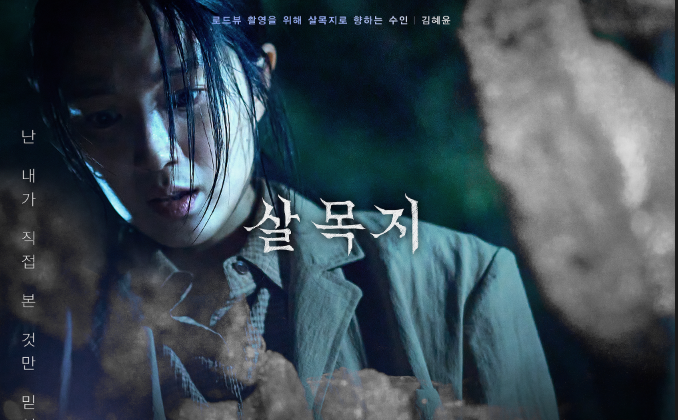
If we think about why movie fans have been so obsessed with zombies for so long, it is likely because zombies are a different kind of monster. In other films, villains usually appear from the outside and invade to ruin everyday life. However, zombies do not just appear from the outside. They are unique monsters where the moment you are infected, you and your loved ones become the “other.”
But these days, zombie stories can feel a bit cliché. The formula of “if you get bitten, you become a monster” is simple, and many films just change the time and place while repeating the same story.
Because of this, you might look at this movie and think, “Another zombie flick?” But if you sit in your seat with that indifferent attitude, you will likely feel as though the director has bitten you from head to toe by the time the credits roll. You will be forced to realize, “So this is how he makes a zombie movie,” or “It is a zombie movie, but it is not just a zombie movie.”
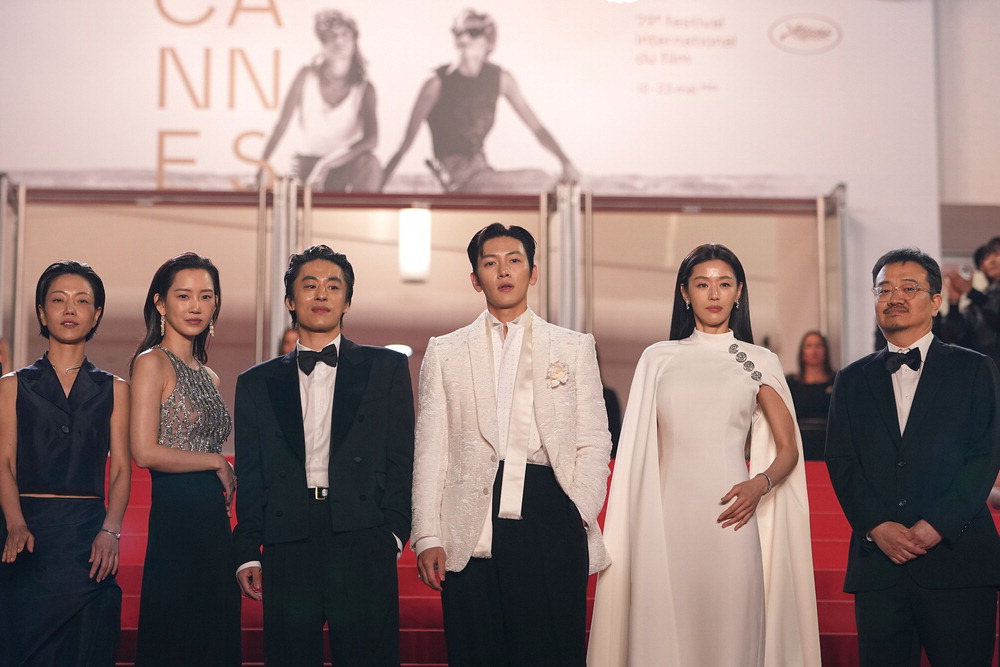
Director Yeon Sang-ho’s new work, ‘Swarm’, which entered the Midnight Screening section of this year’s 79th Cannes Film Festival, has finally been unveiled. The world premiere began at 1 AM on the 16th (local time), and we caught a glimpse of it at the Lumiere Theatre in the Palais des Festivals, alongside the director, actors, and about 2,300 audience members.
Biologist Seo Young-cheol (Koo Kyo-hwan) spreads a virus to get revenge on a company boss who betrayed him, and this virus infects everyone in the same building. The building is locked down, and those who haven’t been bitten are isolated. To prevent the virus from spreading outside, the government has no plans to send rescue teams inside. Survivors like Kwon Se-jeong (Jun Ji-hyun) and Choi Hyun-seok (Ji Chang-wook) must protect themselves.
In terms of “getting bitten leads to infection, and the infected bite others,” the zombies in ‘Swarm’ are like previous zombies. However, Yeon Sang-ho’s zombies this time share “senses and intelligence” in real-time. Before becoming a villain, Seo Young-cheol dreamed of a world of “collective intelligence” where people could share thoughts without language or data through “organic chip information sharing technology.” Consequently, the zombies he created move not as individuals, but as a “swarm,” as the title suggests. For example, if one zombie among those spread throughout the building sees or hears something, that audiovisual information is shared with all other zombies simultaneously. Furthermore, the intellectual ability of one zombie is collectivized and transplanted to others in real-time. The zombies even mimic human behavior and make their own judgments. If a special forces agent becomes a zombie, the entire swarm effectively becomes special forces.
Therefore, these are not the boring zombies from previous movies who just mindlessly rush to bite necks; they are new entities that transcend those intellectual limits, namely, the swarm.
‘Swarm’ possesses a powerful narrative and is overflowing with genre-based fun. However, that does not seem to be all the movie wants to say. It can also be read as an allegory for the fear of the AI era. The relationship between humans and machines has reached a point where machines “consume” human senses and intelligence. The collective intelligence of AI, functioning as a swarm, surpasses the individual human, and the moment a human succumbs to this collective intelligence, they cease to be human. The terrifying fear of a creepy creature in human form absorbing human senses and intelligence and acting more efficiently than a human is embedded in the layers of this film. It is a realistic and tangible fear that “I,” even outside the theater, could be penetrated and replicated by a machine.
Meeting with reporters that afternoon, Director Yeon Sang-ho explained, “While thinking about the principles of how AI operates, I reached the idea of the ‘sum of universal thinking.’ With AI and SNS, rapid exchange has become possible in our era, strengthening universal thinking, which in turn has led to a lack of consideration for minority opinions. I wondered if I could combine this with zombies to make a movie, and that is how ‘Swarm’ was created.”
Jun Ji-hyun’s acting shows a restrained performance without excess, while pushing tension and tragedy to the maximum. While her role in the series ‘Kingdom’ was a hero with special abilities amidst tragedy, her role as Kwon Se-jeong here shows the side of an “ordinary human hero” who removes the swarm’s weaknesses through rational and logical judgment. In particular, actor Koo Kyo-hwan appears as a madman, with the pathetic charm he showed in ‘Everyone is Fighting Their Own Worthlessness’ completely gone. He is filled with malice to turn the world into ruins, yet he walks like a clown on a planned stage. This excitement and lightness actually push the horror of ‘Swarm’ to the extreme.