Heo Young-man met temple food master Gyeho Monk and was utterly amazed by the new flavors.
On the May 24 broadcast of TV CHOSUN’s ‘Sikgaek Heo Young-manui Baekban Gihaeng’ (Heo Young-man’s Baekban Journey), writer Heo Young-man, along with singers Jin Sung and Han Hye-jin, savored temple food at Bukhansan Jinkwansa Temple in celebration of Buddha’s Birthday.
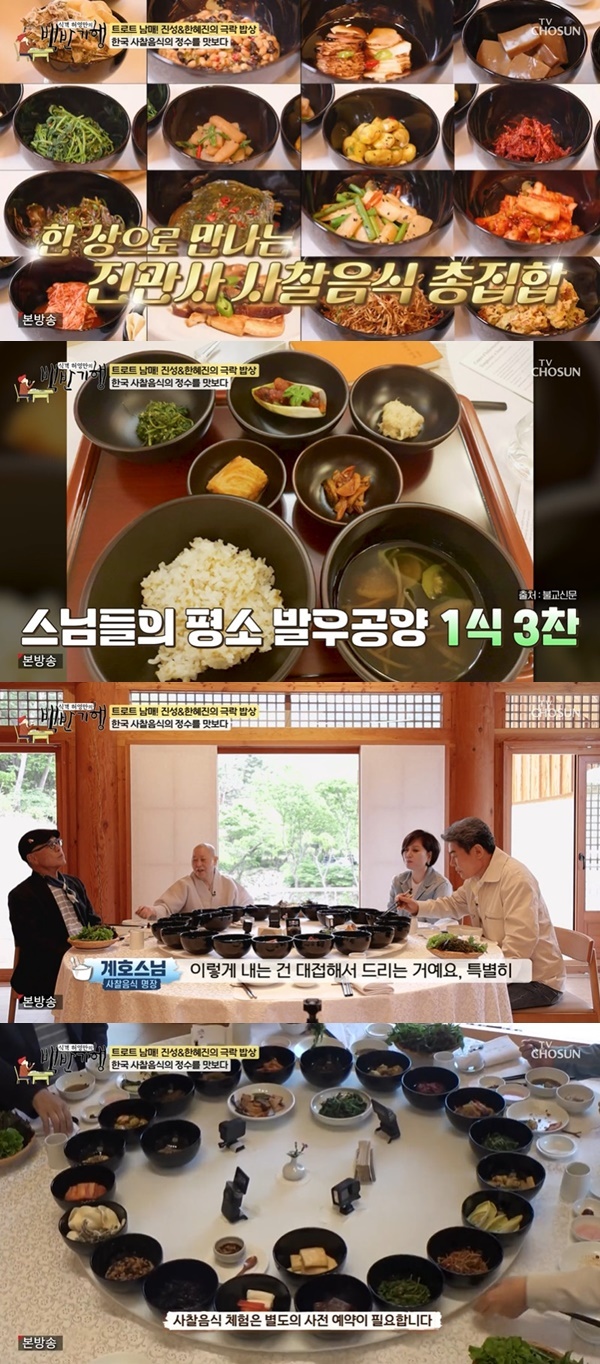
Temple food master Gyeho Monk introduced a delightful array of dishes, including Jerusalem artichoke pickles, aster greens salad, fresh ailanthus leaf kimchi, king oyster mushroom stir-fry, aralia sprout salad, gasiri seaweed, and deodeok root pickles.
Han Hye-jin playfully remarked, “Was that deodeok? Jin Sung sunbaenim thought it was yukhoe (beef tartare) earlier!” Heo Young-man then asked, “Is there a limit to the number of side dishes on a monk’s table?” Gyeho Monk replied, “Yes, there is.” He explained that while a traditional Baru Gongyang (monastic meal ritual) usually consists of three side dishes, they had prepared many more for their special guests.
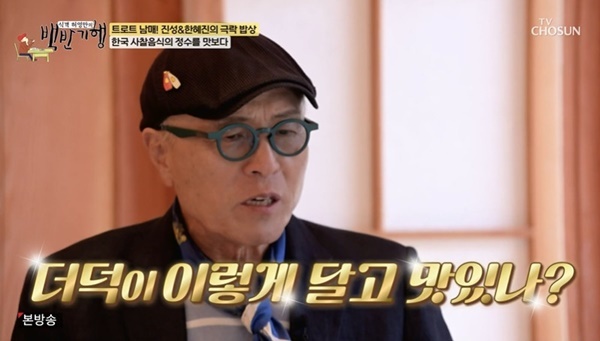
Heo Young-man tasted the deodeok first and exclaimed, “Is it this sweet and delicious?” Han Hye-jin was equally surprised, saying, “It’s really delicious!” Gajuk Bugak (fried ailanthus leaf) was also a rare and intriguing dish. Han Hye-jin commented, “I initially thought this ‘gajuk’ (which means leather) was actual leather. Its name is so unique.” Jin Sung added, “The herb has a distinctive aroma. Some people dislike this smell, but I find it quite appealing.” Gyeho Monk explained, “Gajuk namul has a slight garlic-like scent,” and suggested, “Try eating the gajuk bugak with cheonggukjang (fermented soybean paste) on top.”
The Dubu Jorim (braised tofu) also offered a unique flavor. When Jin Sung noted, “It’s distinctive, with a slightly dried texture,” Gyeho Monk revealed, “I added ginger juice, and a little sesame oil at the end. That’s why it’s so savory and clean.” He further explained, “Jinkwansa Temple historically served as a ‘Joposa’ (a temple designated to make tofu for the royal family). We not only presented tofu to the royal family but also to Changneung and Hongneung (royal tombs).”