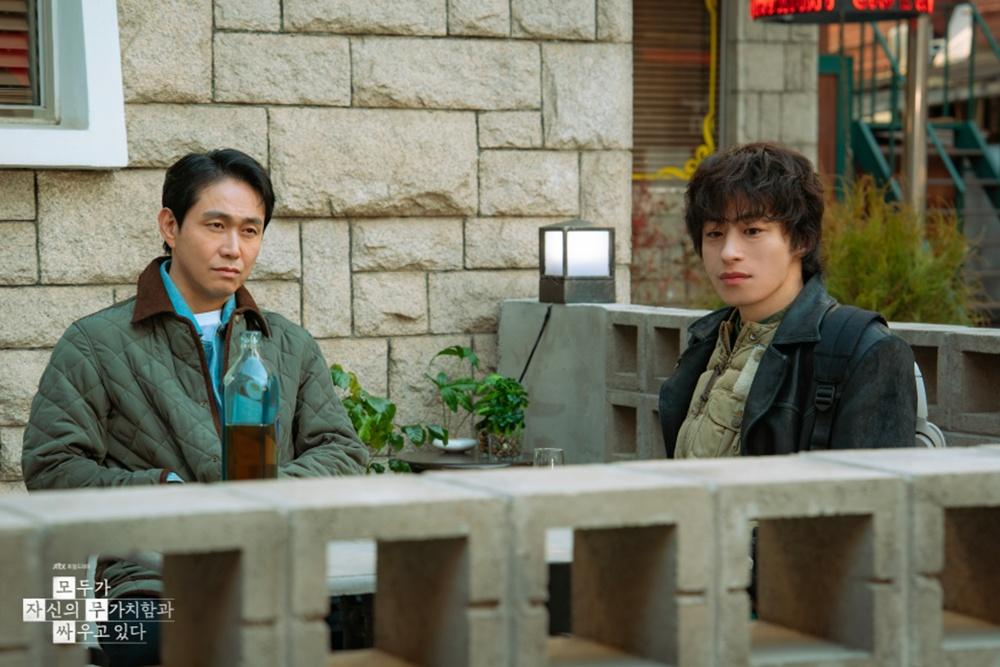
‘Mo-Ja-Mu-Ssa’ avoids provocative plot twists like affairs or scandals. It also doesn’t offer characters that are easy to relate to immediately. Instead, it seems to be successfully building a loyal fanbase through its overall quality and deep narrative.
The recently airing JTBC drama ‘Everyone is Fighting Their Own Worthlessness’ (hereinafter ‘Mo-Ja-Mu-Ssa’) follows Hwang Dong-man (Koo Kyo-hwan) and his quest for peace while battling envy and jealousy among his successful friends. The series was highly anticipated from the start, as it brings together writer Park Hae-young, known for ‘My Mister’ and ‘My Liberation Notes’, and director Cha Young-hoon, who showcased warm humanism in ‘When the Camellia Blooms’ and ‘Welcome to Samdal-ri’.
The cast is also a powerhouse of talent, featuring acclaimed actors like Koo Kyo-hwan, Oh Jung-se, Kang Mal-geum, and Park Hae-joon. According to Nielsen Korea (paid households), ‘Mo-Ja-Mu-Ssa’ started with a 2.2% rating for the first episode and hovered around 2% for a while before jumping to 3.9% by the eighth episode.
In today’s content market, short and intense stimulation often takes center stage. With the rise of Shorts and short-form content, fast pacing, clear good-vs-evil structures, and ‘meme-able’ scenes are what usually grab viewers’ attention. However, ‘Mo-Ja-Mu-Ssa’ takes the opposite approach. It slowly builds the characters’ emotions in the first half, allowing viewers to interpret the story for themselves. While its immediate buzz might seem lower, this is exactly why those who watch it fall deeper into the story.
Most characters in ‘Mo-Ja-Mu-Ssa’ exist on the boundary between good and evil. Some may seem like villains but have understandable backstories, while others reveal selfishness even within righteous actions. This maximizes the sense of realism, as real life is often filled with multifaceted people with their own reasons rather than clear-cut heroes or villains.
Viewer reactions are equally interesting. On online communities and SNS, instead of just enjoying the drama, fans are posting analyses of the characters’ psychology and situations. They discuss everything from a slight change in expression to a single line of dialogue. Some view Hwang Dong-man with pity, while others find him impossible to understand.
The protagonist, Hwang Dong-man, is not a character who can be easily explained. He makes those around him uncomfortable, making it hard to call him a ‘good person,’ yet he carries a deep sense of human deficiency and sadness. Koo Kyo-hwan portrays these complex emotions with his signature detailed acting. Rather than explosive emotions, he uses subtle facial expressions and breathing to reveal the character’s inner cracks, drawing viewers in.
What’s most intriguing is the viewers’ attitude toward Hwang Dong-man. In the past, characters were simply liked or disliked, but now, viewers analyze and debate the character based on their own interpretations. Discussions unfold from various perspectives, seeing him as a wounded human being.
This reminds us of writer Park Hae-young’s previous works. ‘My Mister’ and ‘My Liberation Notes’ followed a similar pattern. ‘My Liberation Notes’ was praised for leaving a heavy resonance in each episode, peering into the depths of human psychology and depression, and questioning the meaning of existence. Its ratings also started at 2.9% for the first episode and rose to 3.8% by the seventh.
In this way, ‘Mo-Ja-Mu-Ssa’ has slowly but surely captured its audience. The response to the work is overwhelmingly positive. While the ratings may not be dominating, the buzz is hot. According to Good Data Corporation’s Fundex, it ranked 2nd in TV-OTT drama buzz just two episodes after airing, with Koo Kyo-hwan ranking 3rd and Go Youn-jung 6th in cast buzz.
The strength of ‘Mo-Ja-Mu-Ssa’ lies in its narrative density. While recent dramas focus on speed, ‘Mo-Ja-Mu-Ssa’ calmly explains the emotions of the characters and the cracks in their relationships, immersing the audience. In terms of mass appeal, it’s certainly not ‘trendy.’ However, in an era overflowing with content that is quickly consumed and forgotten, the weapon of ‘Mo-Ja-Mu-Ssa’ seems clear.