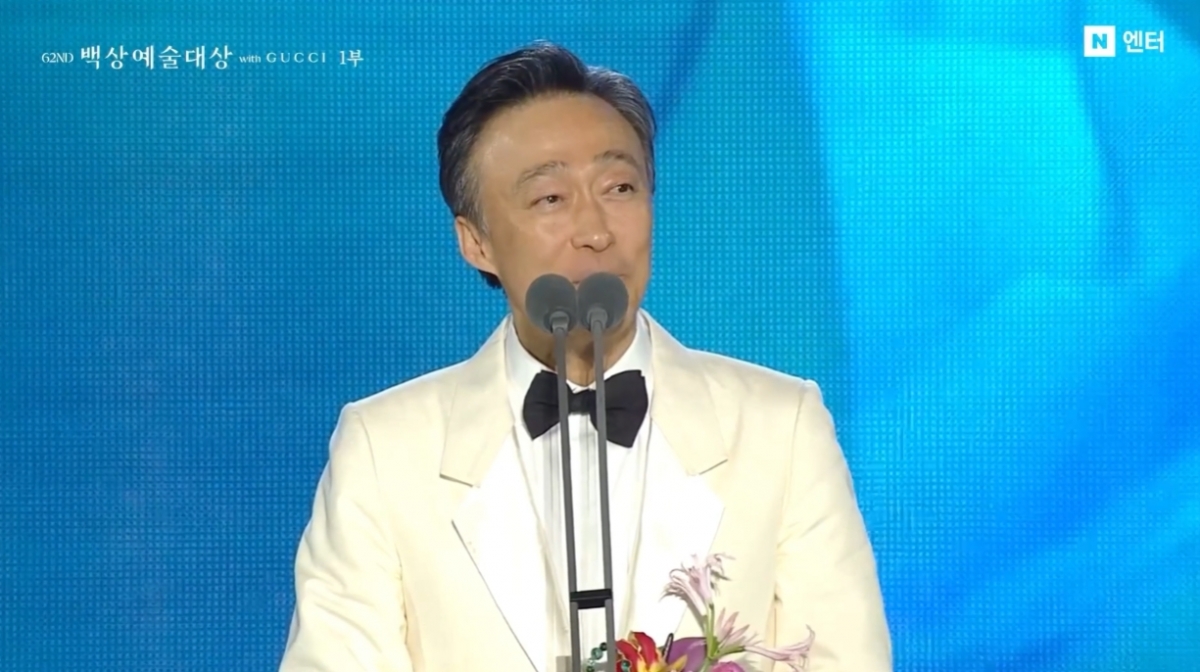
Lee Sung-min took home the Best Supporting Actor award in the film category for ‘I Can’t Help It’ at the 62nd Baeksang Arts Awards held on the 8th at COEX D Hall in Gangnam-gu, Seoul.
He beat out strong contenders like Ryu Seung-bum (‘Good News’), Park Hae-joon (‘Humint’), Yoo Ji-tae (‘The Man Living with the King’), and Jang Yong (‘People and Meat’). Surrounded by congratulations from Director Park Chan-wook, Lee Byung-hun, and Son Ye-jin, Lee Sung-min beamed with happiness as he took the stage. After starting with a “Thank you,” he immediately mentioned Yeom Hye-ran, his on-screen wife in the film.
“When Yeom Hye-ran was a nominee, I was so nervous. I even cursed because Hye-ran didn’t win,” Lee said with an awkward laugh. The audience responded with laughter.
Looking at his expression, tone, and the fact that he mentioned Yeom Hye-ran immediately, it seems his comment about “cursing” wasn’t a criticism of Shin Se-kyung, who won instead, or a complaint about the results. Rather, it felt like an expression of apology and awkwardness that he won while his hardworking co-star, Yeom Hye-ran, did not. He was clearly mindful of the fact that Yeom Hye-ran, who suffered through the production with him, didn’t receive the award.
His wish for Director Park Chan-wook and other actors to “definitely win the Director and Acting awards” also seemed to stem from a desire for his colleagues to be recognized since he felt bad winning alone, rather than an arrogant attitude. He also expressed his regrets to Park Hee-soon, who could not attend the ceremony.
While the blunt phrasing of “cursed” might have been misinterpreted, framing Lee Sung-min as “rude” based on that single word seems excessive.
How did expressing disappointment over Yeom Hye-ran not winning get twisted into criticizing Shin Se-kyung’s win or complaining about the results? It seems some people might find the image of a senior male actor in his 50s mentioning a junior actress’s win, while being cheered on by the likes of Park Chan-wook, Lee Byung-hun, and Son Ye-jin, uncomfortable. This is understandable if reading only the text.
However, there is no actual criticism in his remarks. Lee Sung-min is well-known for taking care of his juniors. Given his usual behavior, while the “cursing” comment might have been a tactless or uncomfortable joke, it is questionable if it is enough to spark a days-long controversy over being “rude.”
Later, Director Park Chan-wook, who won Best Picture for ‘I Can’t Help It,’ tried to ease the tension, saying, “Looking at the results, I’m convinced the judging was fair. Yeom Hye-ran might disagree. Shin Se-kyung also did a great job.” Yeom Hye-ran also helped lighten the mood, joking, “I’m the Yeom Hye-ran who just lost.”
In major Hollywood ceremonies like the Oscars, hosts and winners often trade jokes, satire, and humor. For example, Leonardo DiCaprio’s dating preferences are often a recurring joke, and this year’s ceremony even mocked Timothée Chalamet’s comments regarding ballet and opera. Teasing those who didn’t win alongside congratulating the winners is often handled playfully. The line for acceptable humor varies by country, culture, and individual.
While Lee Sung-min’s speech may have been a tactless joke, was it truly rude enough to cause a controversy for days? His honest and human side is usually seen as charming on variety shows, but it seems to be received differently in reality. It makes one wonder if award speeches are becoming places where people must give robotic, predetermined answers rather than expressing honest emotions.