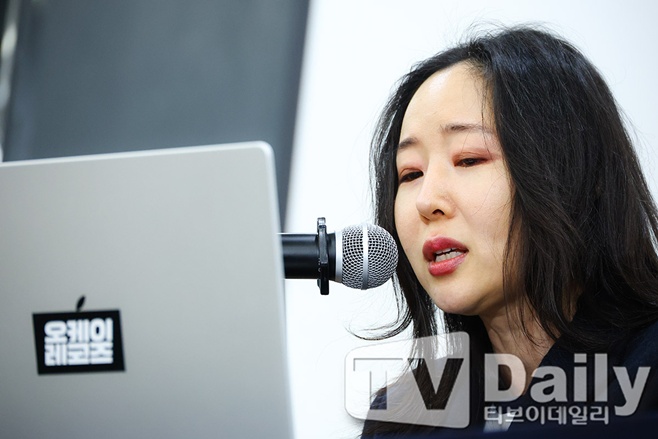
Min Hee-jin, CEO of OK Records, recently appeared as a special lecturer at Chonnam National University for an event marking the 30th anniversary of the 5.18 Research Institute and the 46th anniversary of the May 18 Democratization Movement. Speaking to a crowd of students and citizens at the Yongjigwan Convention Hall, she stated, “Change happens when there is resistance. Even if it doesn’t end in success, resistance carries great significance in delivering a message to the world.”
Regarding the May 18 movement, she emphasized that it is “a fact and a piece of history,” adding that the public should not ignore this history even when it is interpreted differently for political reasons. Regarding her dispute with HYBE, she explained it was a fight to protect NewJeans, stating, “I believed a minimum shield was necessary to protect artists and stop the power of capital from dominating the realm of creation.”
Min’s message is certainly one that many can relate to. The claim that resistance has meaning regardless of the outcome is a value that deserves respect in a democratic society. In fact, she demonstrated her stance by visiting the May 18 National Cemetery before her lecture.
However, there is a point that needs to be addressed. The justification for resistance and the actual results it leaves behind are not evaluated by the same standard. While the “meaning of resistance” can be respected, the public and the industry ultimately look at the results before the intentions.
Specifically, the K-pop industry does not operate on ideals or philosophy alone. While there is no disagreement that the values of creative freedom and artist protection are important, this industry simultaneously functions on competition between massive capital, global platforms, distribution networks, and infrastructure. Ultimately, no matter how clear the justification, it is difficult to avoid a result-oriented evaluation of “what was achieved and protected” within the market.
From that perspective, the claims Min has made since last year need to be looked at coldly again. Based on the facts revealed so far, some were correct, some were wrong, and many areas remain unconfirmed. However, from a result-oriented view, the justification and explanation that this was a “fight to protect NewJeans” seems to be losing persuasiveness as time passes.
In the early stages of the dispute, the NewJeans members showed full trust in Min. On the other hand, ADOR continuously requested the members’ return. Subsequently, NewJeans claimed the invalidity of their contract with ADOR in November last year and sought an independent path, but after repeated legal judgments, they eventually pivoted toward expressing their intention to return.
The problem is the price paid during that process. Team activities virtually stopped during the long hiatus, and the revenue structure was significantly shaken. Meanwhile, the market reorganized quickly. Other teams filled the void left by NewJeans, and the competitive landscape changed. Some evaluate that from HYBE’s perspective, the priority of the “NewJeans risk” has relatively decreased with the emergence of a bigger variable: the full return of BTS.
Ultimately, looking only at the results so far, the parties who suffered are NewJeans, ADOR, and Min Hee-jin. While many lawsuits related to Min are still ongoing, separate from that, it is difficult to easily say “yes” to the question of whether NewJeans were protected.
Min Hee-jin, the “mother of NewJeans,” what did she actually protect?
Ironically, interpretations from inside and outside the industry suggest that the relationship between Min, once called the “mother of NewJeans,” and the members has changed. While there was a strong image of a “community fighting together” early in the dispute, the view is that it has become difficult to maintain that relationship in the same form after long legal battles and activity gaps.
At this point, the nature of the fight changes. With the common front weakened, what remains is a confrontation between an individual and a system. To put it bluntly, no matter how outstanding an individual’s planning capabilities or network may be, there are clear limits to facing the infrastructure, capital, and system of a large entertainment company based on a conglomerate alone. This gap is even more significant in the K-pop industry, where global distribution networks and production/marketing structures are combined.
Furthermore, this fight goes beyond simple planning competition. Min Hee-jin is not a creator who directly performs music production, such as composing, songwriting, arranging, or performing. Ultimately, in a phase where structures and systems clash, there are definitely points where it is difficult to flip the board with individual directing capabilities alone. Under these conditions, the longer the fight lasts, the more disadvantageous it inevitably becomes for the individual.
In that sense, Min’s recent proposal to settle the conflict and lawsuits with HYBE, even if it means giving up some of the conditions for her victory in the put option case, is read as a realistic choice. Lawsuits are not a fight where only one side is consumed. They eat away at time, cost, and emotions.
The justification may remain until the end. However, the industry is ultimately recorded by results. What is needed now may not be more symbolic resistance, but a realistic answer on how to recover the time destroyed by the long dispute.