
Climate economist Professor Hong Jong-ho has issued a warning about the possibility of intense heatwaves this summer.
In the episode of tvN’s ‘You Quiz on the Block’ (hereafter ‘You Quiz’) aired on the 13th, Professor Hong Jong-ho appeared to explain the ongoing abnormal climate phenomena and the issue of global warming.
During the show, Yoo Jae-suk mentioned the current unpredictable weather, saying, “The weather these days is just so unpredictable.” He added, “I’m worried about how hot this summer will be,” to which Professor Hong replied, “It doesn’t seem like this summer will pass by coolly.”
Professor Hong pointed out the temperature rise over the last few years. He noted, “Statistically, the past three years—2023, 2024, and 2025—were the hottest years in history,” highlighting that the global average temperature has risen by about 1.5°C compared to the pre-industrial era.
He further predicted, “While it might not reach a 1.6°C increase this summer, we can certainly expect heat close to the 1.5°C threshold that scientists are concerned about.”
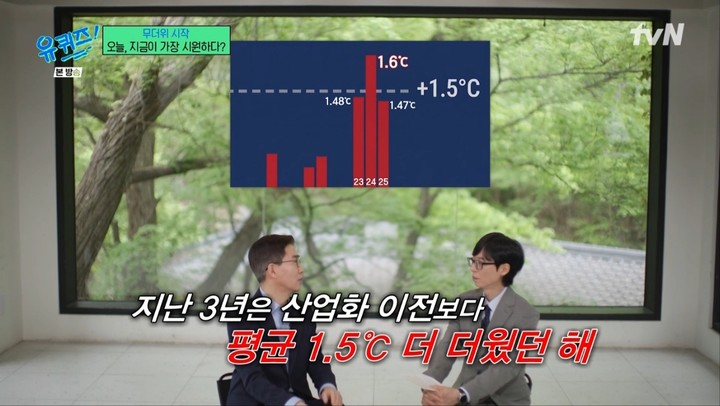


Yoo Jae-suk reacted that it’s hard to feel the impact just by looking at the numbers, saying, “When you say 1.x degrees, it doesn’t feel that significant.” Professor Hong then used a simple analogy involving bathwater to explain.
He explained, “While we can’t compare it directly to water temperature, just think about the difference between a warm bath and a hot bath.” He added, “It feels like a huge difference, but in reality, it’s only about a 1.5 to 2°C difference.” This meant that even a small numerical change can create a massive difference in the actual environment.
Professor Hong also mentioned a more serious future outlook. He emphasized, “If current carbon emission rates continue, projections suggest the global average temperature could rise by 2.8°C in about 70 years.” He stressed that based on calculations of carbon emissions and growth rates, preventing a 2.8°C rise will require immense effort starting now.
The discussion also highlighted how heatwaves are not just a weather issue but can affect the overall economy. Professor Hong stated, “The first to be hit are primary industries such as agriculture and fishing.”



The squid industry on the East Coast was mentioned as a prime example. He explained, “For decades, squid fishing on the East Coast was a representative profitable industry. However, as sea surface temperatures rise, squid are no longer caught as they once were.” He expressed concern, adding, “Fishermen are contemplating whether they should catch different species. If they cannot adapt quickly to these changes, they could suffer enormous losses.”
He further explained that the decline of primary industries could lead to a chain reaction of hits to the food industry, catering, and tourism. A decrease in agricultural and fishery production could eventually impact the entire economy. He warned that global warming could even lead to a decline in global GDP in the long run.

Professor Hong mentioned renewable energy as a solution to the climate crisis. He said, “Economists have high hopes for technology. I hope we can rediscover solar and wind power to make South Korea safe from the climate crisis.”