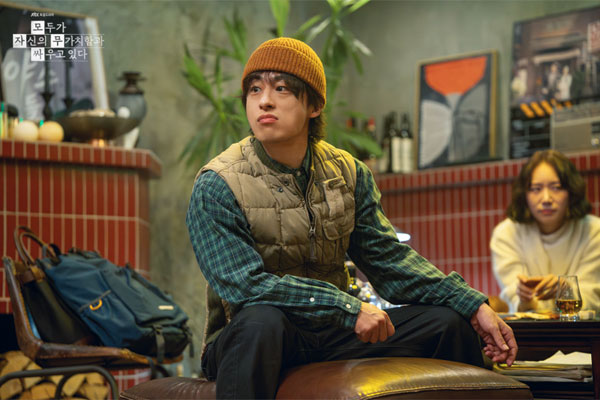
“Why are movies and dramas all like this lately? They’re all the same, like they were put through a machine.” In the JTBC weekend drama Everyone is Fighting Their Own Worthlessness (hereafter Mo-Ja-Mu-Ssa), Noh Kang-sik (Sung Dong-il), a big shot in the film industry, complains. He has a point. There are so many dramas these days that feel like they were ordered from an AI. While Noh Kang-sik finds everything boring, fortunately, a few masterpieces emerge every year, such as Netflix’s Eunjung and Sangyeon and tvN’s Unknown Seoul, which were recognized at the 62nd Baeksang Arts Awards. And now, a work that rivals them has arrived: the currently buzzing Mo-Ja-Mu-Ssa.
With 8 episodes out of 12 already aired, it’s sad that there are only two weeks left until the finale. While watching the original broadcast is great, I highly recommend the ‘replay.’ There are so many lines you can’t afford to miss, fleeting expressions, and sophisticated emotional exchanges that you’ll find yourself rewinding to study them.
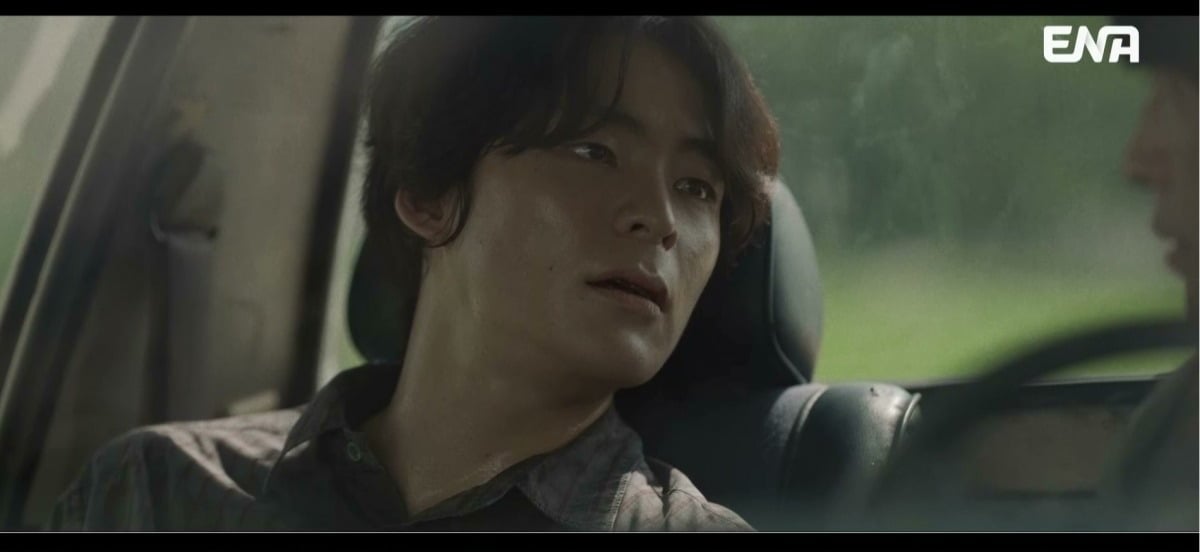
I’ve heard that quite a few people dropped the show in the first week because they couldn’t stand the ‘pathetic’ behavior of the protagonist, Hwang Dong-man (Koo Kyo-hwan). Some likely stuck it out solely based on their trust in writer Park Hae-young and director Cha Young-hoon. Considering the current trend of preferred protagonists on OTT platforms, casting Koo Kyo-hwan as the character ‘Hwang Dong-man’ was an immense act of courage and a bold challenge.
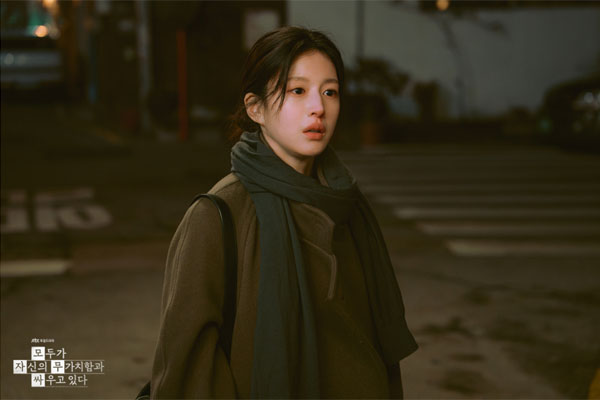
Following writer Park Hae-young’s previous works, tvN’s My Mister and JTBC’s My Liberation Notes, this drama focuses on ‘everyone’ rather than just ‘me.’ Perhaps that’s why relatable lines that feel like they’ve seen right through my soul pour out throughout the show. For example, there’s a scene where Byeon Eun-ah (Go Youn-jung) snaps at a colleague who sarcastically says, “I really don’t understand how anyone could like a man like Hwang Dong-man.”
“If you just hate him, say you hate him. Why do you keep saying you ‘don’t understand’? Why pretend to be nice? I wish you would just be honest and clear with your words.”
Those words felt as if Byeon Eun-ah was speaking directly to me. Working as a broadcast critic, I’ve probably said “I don’t understand” over a hundred times. I’ve wanted to say, ‘Why do you keep putting people who are clueless, lazy, and incredibly rude in front of me? I absolutely hate it,’ but in reality, I say, “I don’t understand from my perspective,” or “It’s difficult to understand.”
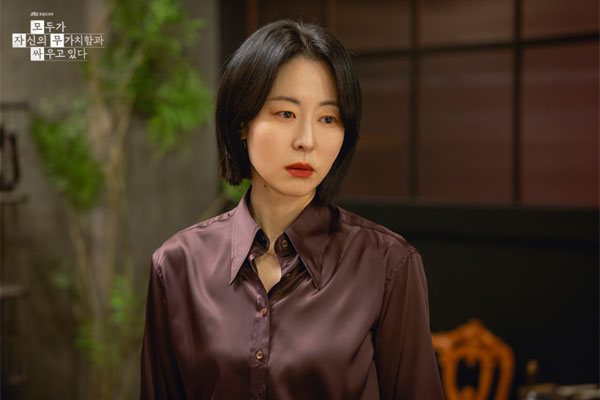
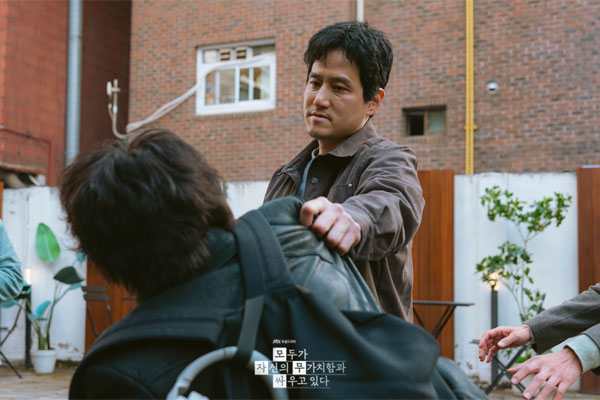
In episode 5, after receiving a contact from her ex-boyfriend Ma Jae-young (Kim Jong-hoon), Byeon Eun-ah mutters to herself, “I wish I had an older brother. A really crazy, wild older brother.” As if he heard her, Hwang Dong-man visits Ma Jae-young and goes on a complete rampage. Though I’ve never said it out loud, I’ve occasionally thought that it would be nice to have a sibling like that—someone who would go wild for me, or a strong-willed older sister like Ha Yoo-mi in the SBS drama My Man’s Woman.
This is how you gradually get drawn in. The refreshing dialogue, especially the verbal prowess of film company CEO Go Hye-jin (Kang Mal-geum), is truly legendary. In old dramas by writer Kim Soo-hyun, every character spoke so well it felt like they were possessed by a ghost who died without getting to speak. This drama is the same. How do they only say things that are so spot on? When combined with the acting skills, it’s the icing on the cake.
Furthermore, there are twists everywhere. One of them is the fact that Hwang Dong-man’s brother, Hwang Jin-man (Park Hae-joon), was a real poet. While suffering from the inability to find his daughter, Young-sil, a brilliant poetic inspiration struck him, and the resulting poem was praised by critics as a masterpiece. I can vaguely guess why Hwang Jin-man keeps wanting to die. Perhaps he loathes himself for constantly coming up with shining poetic phrases. Yet, a fan, upon hearing that the poem came from the pain of losing a daughter, says, “It’s beautiful.” He may write poetry, but his empathy is at rock bottom.
There are some disappointing points. First, the revelation that Byeon Eun-ah’s mother is actually actress Oh Jung-hee (Bae Jong-ok). I wondered if that was too cliché, and it actually happened. It even leads to a plot where Oh Jung-hee’s biological daughter and stepdaughter meet as a PD and an actress and become close—the kind of development you’d see in a ‘makjang’ drama. To show how common this setting is, the protagonist Dam Ye-jin (Chae Won-bin) of the current SBS Monday-Tuesday drama Sold Out Today was also abandoned by her actress mother, Song Myung-hwa (Woo Hee-jin). Both Byeon Eun-ah and Dam Ye-jin suffer from childhood memories of being denied by their mothers; Byeon Eun-ah frequently gets nosebleeds, while Dam Ye-jin suffers from insomnia. However, in the case of Mo-Ja-Mu-Ssa, the dialogue and characters are so vivid that it didn’t feel cliché.
Another disappointment is that writer Park Hae-young tends to portray older women—mothers and grandmothers—quite flatly. In My Mister, the three brothers’ mother, Byeon Yo-soon (Go Doo-shim), is introduced as a mother who ‘pours out a bucket of curses in a fit of rage but still makes warm meals three times a day.’ The obsession with meals was similar for the mother Gwak Hye-sook (Lee Kyung-sung) in My Liberation Notes*. Without much narrative, she just set the table every meal, helped at the factory, did farm work, and eventually died in a hollow way.
In Mo-Ja-Mu-Ssa, Byeon Eun-ah’s step-grandmother, Ga Su-ja (Yeon Woon-kyung), is not much different. It’s said she devotedly fed and clothed a child who feared being abandoned after their father died. It’s warm. It’s touching. But that’s it. She has no dreams, no pleasures, no friends, and not even a hobby. Does writer Park Hae-young view older women merely as beings who cook for the protagonists? One could say it’s a reflection of reality, but is this the 1980s?
Despite this, Mo-Ja-Mu-Ssa is a drama you must watch. It seems likely that discussions will break out everywhere. And because this is a drama about various human types, I encourage you to look for ‘yourself’ somewhere within this story.