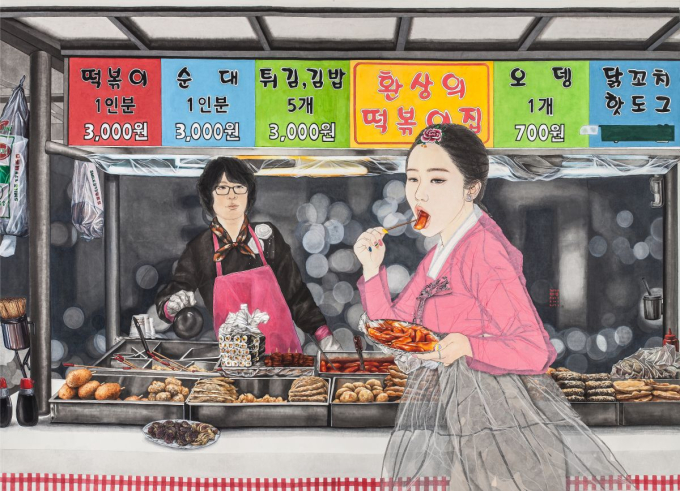
 , 111x160cm, ink and light color on hanji, collage, 2016. / Source: Kim Hyun-jung Art Center)”/>
The nights in Gangnam are dazzling. The signs never stop glowing, people move about until late, and the city seems tireless. Yet, beneath those lights, people often feel an emptiness inside. The fatigue of the commute, the void between appointments, and the tension of enduring a day alone linger in the throat. In those moments, Koreans find themselves completely disarmed by the sight of red seasoning on the street. Tteokbokki is more than just a snack; it is an instant comfort granted by the city.
The artwork
The true power of this work lies in the fact that it doesn’t look for “the most Korean thing” in museum artifacts. Being Korean isn’t limited to old palaces, ancient paintings, or traditional patterns. The Korean spirit lives on in the lived experience of eating tteokbokki at a street stall on the way home, the habit of ordering sundae and fried food together while sipping fish cake broth, and the act of swallowing the day’s stress with a spicy kick. The sight of a figure in hanbok eating street food feels unfamiliar, yet strangely familiar. It is a scene showing that tradition and modernity do not clash, but have already been living together in our daily lives.
The numbers on the menu make this piece even more special. The price of 3,000 won for a serving of tteokbokki is more than just information. In this painting created in 2016, 3,000 won tteokbokki has already become a thing of the past. A price that was natural at the time has become a record testifying to the cost of living and the sensibilities of an era. Future viewers might say, “Wow, tteokbokki used to be 3,000 won back then.” That statement carries more than just a sense of inflation; it holds memories of student snack money, hunger on the way home, and the street foods chosen based on the budget in one’s pocket. Painting doesn’t always record an era by depicting grand events. Sometimes, a small number on a menu testifies to the times far more accurately.
The record isn’t just about the price. If you look closely, the unique lifestyle of street stalls is captured everywhere. The plates holding the tteokbokki and sundae are wrapped in plastic, a practical method used by stalls to reduce dishwashing. Napkins are hung for easy access, and the lights are covered in plastic to prevent oil splatters, food smells, and moisture from sticking. To some, these may be trivial sights, but it is precisely this triviality that makes this work a 21st-century genre painting. While genre paintings of the late Joseon Dynasty recorded markets, taverns, play, and labor, today’s customs are found in the street stalls of Gangnam Station, plastic-wrapped plates, protected lights, and bundles of hanging napkins.
The night street in the background is treated with blurred lights. The neon signs and car lights of Gangnam blur into circular traces of light, while the street stall and the figure in front stand out sharply. This contrast creates the emotional core of the work. From a distance, the city looks glamorous, but inside, it is exhausting. Conversely, the street stall is humble, but in front of it, one’s heart becomes clear. Between the blurred city lights and the vivid red of the tteokbokki, the viewer sees the night of a Korean urbanite. A time that is glamorous yet empty, busy yet hungry. And the power of cheap food that helps one endure that time.
The red seasoning of the tteokbokki feels like a color of emotion in this work. The spicy, sweet, and sticky taste is deeply connected to the Korean sense of life. It is eaten when sad, when stressed, or when chatting with friends. It doesn’t need to celebrate a special day like food at a high-end restaurant. Tteokbokki is, instead, the food for non-special days. That is why it is more powerful. It is there on failed days, exhausted days, and days when nothing happened. The way the figure in
This is where “pretense” (naesung) comes into play again. Hanbok evokes formality and neatness. However, the figure wears these formal clothes while eating the most common and explicit of foods. Sauce might get on the lips, and dignity might be forgotten. Yet, the expression remains composed. The heart that is elegant on the outside but moves directly toward what it wants to eat on the inside is exactly what “pretense” is. This pretense is not hypocrisy, but a human crack. People always waver slightly between the dignity demanded by society and the desires wanted by the body. And that wavering may be the most honest face of all.
The presence of the street stall owner in the work is also important. He is not just part of the background, but a witness to the customs of this era. Wearing a pink apron and standing before the food, he represents street labor. While tteokbokki is comfort for some, for others, it is a livelihood and labor. The city night is not completed by those who eat alone. There are people who keep the lights on, heat the oil, and boil the seasoning until late. The eater, the seller, and the passing city lights together form the era within a single screen.
This work was modeled after a real street stall near Gangnam Station, and the actual business name and prices were left in the painting. The artist gave the art book and exhibition tickets to the stall owner who served as the model. The painting takes reality, puts it on the canvas, and then returns to the person in that reality. The artist wanted art to not stop at observing life, but to reconnect with it. A painting in a museum and a street stall may seem far apart, but within this work, they belong to the same world.
The artist did not just want to capture a woman eating tteokbokki. They wanted to capture what has provided comfort to Korean society. Expensive things do not explain an era. Rather, a 3,000 won plate of tteokbokki can sometimes say much more. The budget of youth, the fatigue of the commute, memories of sharing with friends, and nights spent getting through the day with a spicy taste. All of that is placed upon this red plate.
The nights of Gangnam are still glamorous, and people are still busy. But amidst that, someone still stands before a street stall today. They stop for a moment to eat tteokbokki, drink fish cake broth, and then walk back into the city as if nothing happened. That short pause might be the small ritual that has sustained Korean life. The 3,000 won on the 2016 menu has become a price of the past, but the comfort received in front of it has not disappeared. The work is currently on display at Gallery UHM until May 20.
![[Portraits of Korea by Korean Painter Kim Hyun-jung ⑭] How much is the 3,000 won in this painting worth now (Source: Kim Hyun-jung Art Center)](https://t1.daumcdn.net/news/202605/15/bntnews/20260515100220140ripr.png "How Much is 3,000 Won Now? The Comfort of Tteokbokki in Kim Hyun-jung's Art 2")